
Summary
- As of the most recent funding round's valuation, WeWork would be the second-largest IPO of 2019, trailing only Uber.
- WeWork has copied an old business model, slapped some tech lingo on it, and suckered venture capital investors into valuing the firm at more than 10x its nearest competitor.
- The company also burns tons of cash, carries huge risk factors in a recession, and sports some of the worst corporate governance practices we’ve ever seen.
- I do much more than just articles at Value Investing 2.0 : Members get access to model portfolios, regular updates, a chat room, and more. Get started today »
WeWork – now rebranded as The We Company (WE) – filed its initial S-1 on Aug. 14, and the company reportedly plans to go public in September. We don’t have official pricing information, but the company’s most recent funding round – a $2 billion investment from SoftBank (OTCPK:SFTBY) in January – valued the co-working company at $47 billion. At this valuation, WeWork would be the second-largest IPO of 2019, trailing only Uber (UBER).
WeWork might not be the largest IPO of 2019, but it's easily the most ridiculous, and the most dangerous. At least Uber and other recent big-money IPOs offered some legitimate innovation in their business models even if their valuations were far too high. WeWork has copied an old business model, i.e. office leasing, slapped some tech lingo on it, and suckered venture capital investors into valuing the firm at more than 10x its nearest competitor. The company also burns tons of cash, carries huge risk factors in a recession, and sports some of the worst corporate governance practices we’ve ever seen. WeWork is in the Danger Zone.
No Innovation in the Business Model – Just More Risk
WeWork was founded in 2010 in the SoHo district of New York City to provide co-working space, primarily for freelancers and small startups. In the nine years since its founding, the company has grown rapidly and consists of 528 locations in 111 cities and 29 countries.
While WeWork is growing rapidly, the service it offers is not new. The Belgian company IWG, which operates under the brand name Regus and a variety of other, smaller brands, utilizes the same business model of leasing office space, refurbishing it, and sub-leasing it under shorter terms to tenants.
IWG has more square feet of office space than WeWork, earns more revenue, and actually earns a profit. However, IWG has a market cap of just $3.7 billion, less than 10% of WeWork’s most recent valuation. The primary difference between the two is that WeWork describes its business model in the faux-tech lingo of “space-as-a-service” and its mission as “elevating the world’s consciousness.”
Figure 1: WeWork vs. IWG – Which Would you Buy
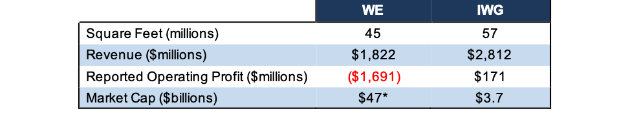 * Market cap for WE estimated using valuation in latest funding round
Sources: New Constructs, LLC and company filings
Another difference is that WeWork operates with a much higher degree of risk by taking on significantly more operating lease commitments with longer terms and more geographic concentration.
WeWork has ~20% less usable square feet of office space than IWG, but almost five times as many operating lease obligations at the end of 2018. Two main factors account for WeWork’s massive amount of operating lease obligations compared to IWG:

