
Summary
- Megacities like LA/NY/SF will thrive long term. Apartment rents/occupancy are stable in the short term as well (relative to most businesses). AVB's occupancy was 94.8% and rent collections were 97%.
- Fortress balance sheet with loan to value less than 25%. Well positioned for opportunistic acquisitions and development or NAV accretive buybacks (AVB announced a $500 million buyback with 2Q results).
- AvalonBay trades at a significant discount to its private market value. The stock is inexpensive and has a dividend yield of 4%.
- The combination of stable revenue, a strong balance sheet, and low valuation make AvalonBay a safe stock for long-term investors. When the market realizes this, shares will appreciate.
- AvalonBay could be attractive to an activist or private equity group, especially with the 10-year Treasury at 0.7%.
Like most multi-housing REITs, AvalonBay's (NYSE:AVB) shares have been battered thus far in 2020, falling 32% from their 52-week high. The market's chief concern seems to be that megacities like SF, LA, and NY will see a population exodus, as COVID/government restrictions imposed as a result of the pandemic make city living less attractive. While anything can happen in the short term, we firmly believe that cities are alive and well. As a long-term investor, I view the current price as a fantastic investment opportunity and am long shares of AVB.
Overview
AvalonBay owns a collection of institutional quality apartment buildings in supply constrained markets with favorable, long-term characteristics.
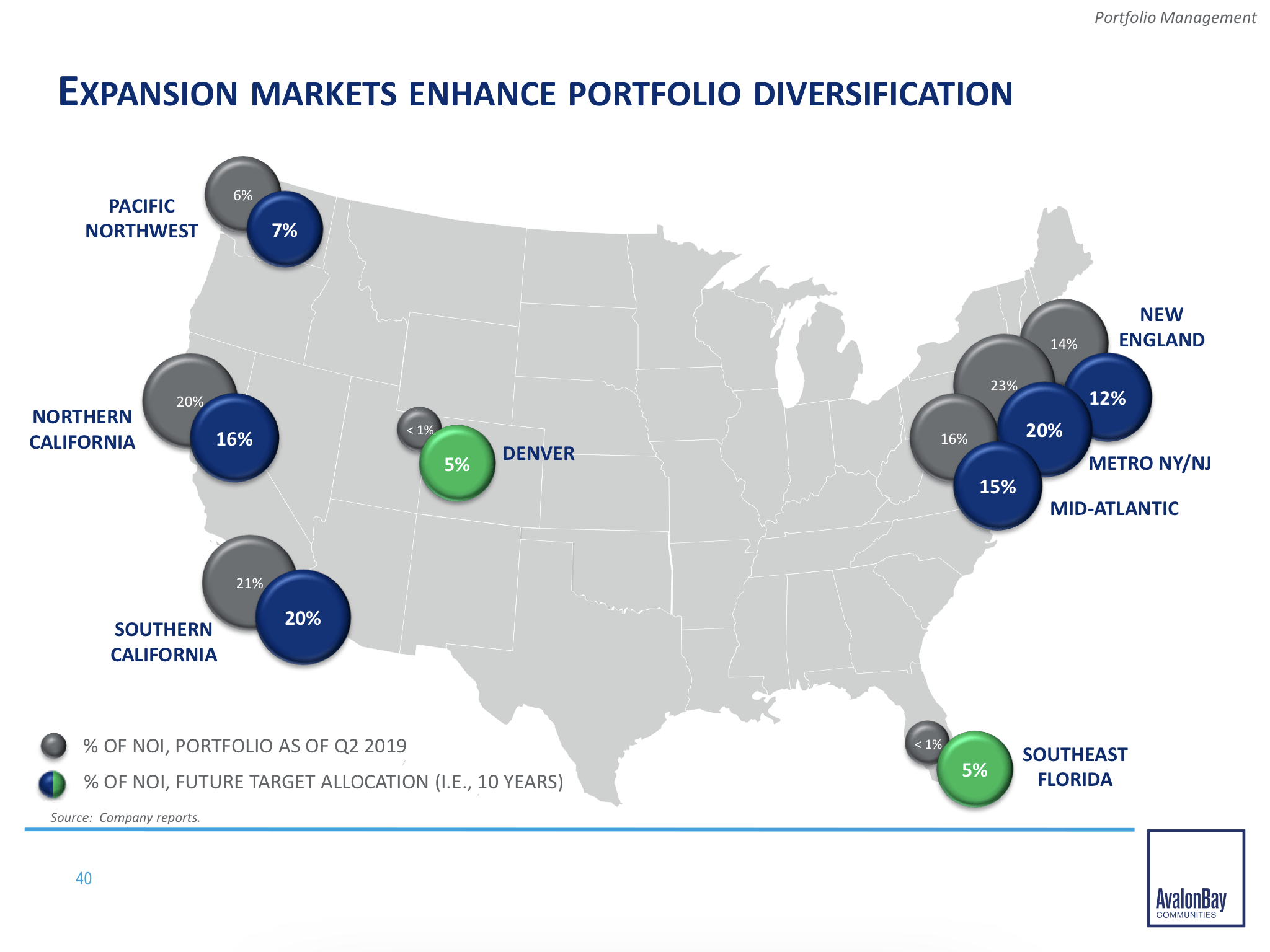 While California has a few challenges, it is home to 3 of the 10 largest (Facebook (NASDAQ:FB), Google (NASDAQ:GOOG) (NASDAQ:GOOGL), Apple (NASDAQ:AAPL)) companies in the world by market cap as well as Tesla (NASDAQ:TSLA), Netflix (NASDAQ:NFLX), Nvidia (NASDAQ:NVDA) (to name a few). Seattle has two of them (Microsoft (NASDAQ:MSFT) and Amazon (NASDAQ:AMZN)). There is long-term structural income growth in these markets which supports housing prices.
I've written about my long-term belief in all things California. To me this is blatantly obvious. Headlines suggest that CA will fall apart but look at how many giant tech companies are located in California. Why would you not bet on SF/LA over the long term?

